

Create from-scratch savory and delicious vegan tamales recipe filled with tender cauliflower in a nutty pipián rojo sauce. These tamales are so good, even non-vegan friends will come back for seconds. Follow the step-by-step video for instructions.

Welcome to day 7 in my first annual ¡Hola! Jalapeño’s Tamalidays!
I launched this epic Christmas tamales countdown last week. So far I’ve shared three tamales recipes including vegetarian tamales with cheese and epazote, Piña Colada sweet tamales, and Tamales de Rajas (charred green chiles). I’ve also shared a few tamales-making tutorials like a step-by-step visual guide to making tamales and 4 ways to tell if your tamales are ready. And if you plan on making tamales to serve at a Christmas party, I’ve got a post all about what to serve with them as well.
Today I’m sharing something different—a vegan tamales recipe that is so good, even your non-vegan friends will be beaming.
Let’s make Pipián Rojo Cauliflower Tamales!

This delicious recipe includes soft, fluffy, pillowy masa stuffed with tenderly cooked cauliflower in a luscious pipián rojo sauce. They have all the comfort of a cozy blanket with the goodness of lots of veggies.
Tamales may not be the healthiest food on the planet but they are actually a great thing to make if you are entertaining friends with special diets this holiday. These are not only vegan, but all tamales are naturally gluten-free! Try my vegan tahini potato and kale tamales too, these are so good with habanero tomatillo salsa.
What is Pipián Rojo?

You may be familiar with pipián sauce being green and it is sometimes called green mole or mole verde. The main ingredient is pepitas or pumpkin seeds, which give the sauce a creamy texture when toasted and blended.
The version we’re making today has the traditional ingredients of pipián verde: tomatillos, cilantro, pepitas, jalapeño as well as dried ancho chiles, peanuts, and sesame seeds. The finished red chile sauce is silky, smooth, warm, and cozy with just a hint of heat from the blistered jalapenõs.
Step-by-Step Video
How To Make This Vegan Tamales Recipe
If you need more direction, be sure to watch the video above that has step-by-step instructions.
The first step for these homemade tamales is to make the pipián sauce. We will use half for mixing with the cauliflower filling and the other half for serving over the tamales. Start by charring the onions and garlic. Then blend softened ancho chiles with the remaining ingredients. Sauté the sauce in refined coconut oil or vegetable oil. Taste and add a teaspoon more salt if needed.
Next up? Soak the corn husks. Bring a large pot of water to a boil, remove from heat and submerge the corn husks in the hot water. Once soft, remove them from the water with tongs, letting any excess water drip back into the pot.
*VARIATION #1: Use banana leaves to wrap these tamales instead of corn husks. Find out how in my banana leaves tamales tutorial.
Now we blanch the cauliflower. Boil in a pan of salted water until just barely tender, drain, then plunge into a large bowl of ice water. Drain again and toss with 3 cups of the sauce. Taste and season with salt if needed.

Then it’s time to make the masa dough. Since we are making vegan tamales we are going to use vegetable shortening instead of traditional lard for the tamale dough. You can also use vegan butter or coconut oil. I don’t like to use a liquid oil like vegetable oil or olive oil. I don’t think the masa comes out as fluffy.
As for the liquid, warm vegetable broth or vegetable stock and use that to rehydrate the masa harina.
Beat the shortening, tablespoon baking powder, and salt together in the bowl of a stand mixer on medium-high speed for 5 minutes. Slowly add the rehydrated masa flour. Add more warm vegetable broth until it reaches a fluffy thick cake batter consistency.
*VARIATION #2: If you don’t have an electric mixer you can also make the masa by had with a wooden spoon. Beat vigorously to whip as much air as possible into the tamales.
Time to assemble! Spoon about 1/3 cup of the corn masa into the center of the corn husk. Spread evenly over the center of the husk leaving a 1/2 inch border on the sides. Spoon about 1/4 cup of the filling onto the center of the dough. Fold the long side over to meet the other side and roll up.

Last is steaming the tamales. Have the steamer filled with water and already steaming over medium heat. Place tamales open side up leaning them against the side of the pot so they don’t fall over. Top with a layer of corn husks. Steam tamales for about an hour. Check after 45 minutes.
*VARIATION #3: If you don’t have a steamer you can also cook these in an Instant Pot, slow cooker, or even a Dutch oven with a steamer basket. Read all about these other options in this detailed post.
So… what do the final tamales look like? Eat your heart out!

I like serving the tamales with a generous spoonful of pipián sauce and more toasted pepitas. My sofrito black beans, refried beans or crock pot pinto beans make good sides for a delicious meal.
I love vegan and plant based Mexican food (I mean I wrote a whole cookbook about it) but I’ve never fallen in love with vegan tamales until now. These are absolutely insane. Some friends came over for dinner the day that I tested the recipe and all 2 dozen tamales were gone within 1 hour. Pretty sure that’s a record in my house.
Speaking of friends, I highly recommend hosting a tamalada (tamales-making party), inviting over friends and family the next time you are making tamales. They are easier if you do it like an assembly line; one person spreads the masa, one person adds the filling, one person folds them, and the last person loads up the steamer.
Lastly, if you have leftover tamales they will keep in an airtight container in the refrigerator for 5 days or freeze leftover tamales for up to 6 months.

Favorite Holiday Mexican Vegan Recipes
Check out my 40+ easy and delicious vegan Mexican recipes including:
- Guacamole with Charred Poblano Peppers
- Cranberry Agua Fresca with Mint & Lime
- Mexican Vegetable Soup with Sweet potato
- Cilantro Jalapeño Hummus
- New Potato and Chard Tacos
- Baby Kale & Avocado Salad with Grapefruit Vinaigrette
- Fig Chipotle Jam
- Blistered Sweet Potatoes with Serranos & Lime
Would love to know if you plan on making tamales this holiday season! If yes, what flavor?
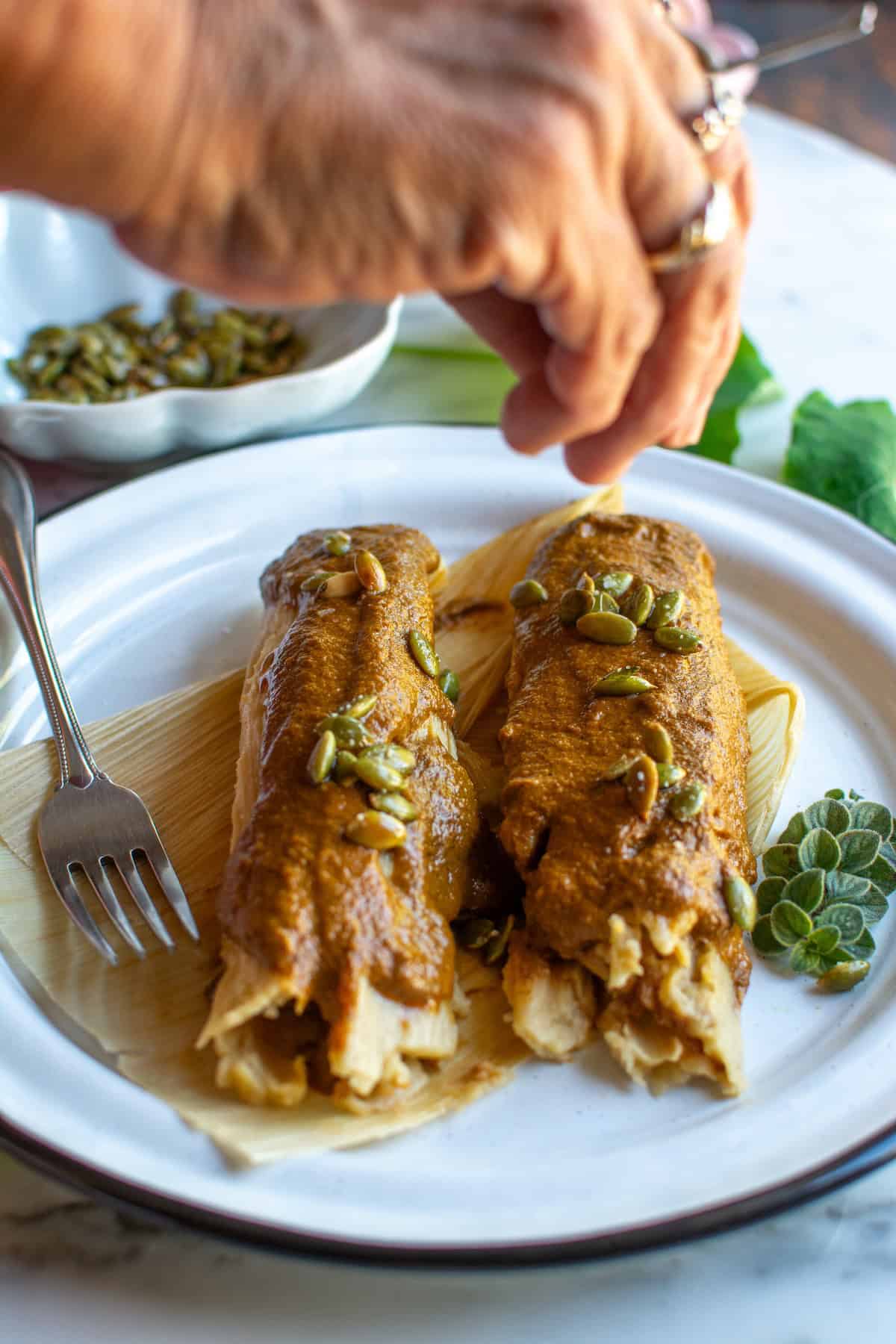
Vegan Pipián Rojo Cauliflower Tamales
Ingredients
Equipment
Method
- Heat a comal or a large dry frying pan (ideally cast iron) over medium heat. Place the 4 ancho chiles on the hot comal and toast, flipping frequently, until darkened in color and fragrant, be careful not to burn.
- Bring a medium saucepan of water to a boil over medium-high heat. Add the toasted chiles and the 1/2 pound tomatillos to the water. Reduce heat to a simmer and simmer until chiles are soft and tomatillos are cooked but not split open, about 10 minutes. Remove from the heat.
- Heat the comal once again over medium heat and place the quartered onion, jalapeño, and 2 garlic cloves on the hot comal or frying pan. Char the vegetables until they are blackened on the outside. Remove the garlic as it cooks—it will cook faster than the others. Keep flipping and turning the pieces so they char on all sides. Remove them to a heat proof bowl and let cool slightly, Once cool, cut off the stem of the jalapeño.
- Heat 2 tablespoons of the vegetable oil in a medium frying pan over medium heat. Add the 1/4 cup pumpkin seeds and 1/4 cup peanuts. Fry in the oil until golden and fragrant, about 2-3 minutes. Add the 2 tablespoons sesame seeds and remove from the heat. Stir frequently as they cool to prevent the sesame seeds from burning.
- Place the charred veggies in a blender. Remove the chiles and tomatillos with kitchen tongs and place them in the blender as well. Finally add the toasted nuts and seeds, the 1/2 cup cilantro and the 2 teaspoons kosher salt. Add a ladle of the chile cooking liquid and blend until very smooth.
- Heat the remaining 2 tablespoons of the oil in a large pot over medium heat. Once the oil is hot, add the pureed chile mixture and stir—be careful the sauce will spatter. Keep stirring, frying in the oil until the color darkens and it thickens slightly.
- Add the 3 cups vegetable broth and bring the sauce to a low simmer. Cook, covered for about 15 minutes or so to let the flavors concentrate. Taste and add more salt if necessary. Sauce can be made up to 5 days in advance or frozen for up to 3 months.
- Heat the 10 cups vegetable broth in a large saucepan over medium-high heat until just simmering.
- Place the 6 cups masa harina in a large heat-proof bowl. Pour 6 cups of hot broth over the masa harina and mix with a wooden spoon to combine. You are just rehydrating the flour here, it will not be soft. If it seems really dry, add another cup or so of broth. Cover with plastic wrap and let sit while you whip the shortening.
- Combine the 1 cup vegetable shortening (or whichever fat you are using) with the 1 tablespoon each baking powder and kosher salt in the bowl of a 5-quart or larger stand mixer fitted with the paddle attachment. Beat on high for about 5 minutes. This may seems extreme but it really makes a difference on how fluffy the masa turns out.
- Stop the mixer, scrape down the sides of the bowl and turn it back on to medium-low speed. Add the rehydrated masa, a handful at a time letting the first handful mix in before adding more. Keep going until all the masa has been added.
- The dough should be very soft, almost soupy. It will stiffen as it sits so it is better for it to be on the wet side at this point. If it isn't like thick, fluffy cake batter, add more warm broth until it reaches that consistency.
- Bring a large pot of water to a boil over high heat. Once it is boiling, turn off the heat and add the corn husks. Submerge them under the water with kitchen tongs. Set aside.
- Bring another large pot of, this time, heavily salted water to a boil over high heat. Add the 8 cups of cauliflower florets and return to a boil. Cook 2-3 minutes or until barely tender (they will finish cooking in the tamales). Drain and plunge into a large bowl of ice water to stop the cooking.
- Drain cauliflower again and place in a large bowl. Add 3 cups of the pipián sauce, the 1/3 cup lime juice, and the 2 teaspoons kosher salt and stir to combine.
- Fill the bottom of a vapora or tamales-steamer with water. Place the steamer insert inside the steamer. Cover the bottom of the insert with corn husks that are ripped or too small. Cover and bring to a boil over high heat. Once boiling, lower heat to medium-low and keep covered and filled with steam until you are ready to fill with tamales.
- Drain the corn husks. Place one on a clean surface and wipe any excess water with a towel. Arrange so the wide end is facing toward you.
- Check masa to make sure it didn't get too thick while it sat. If so, add more broth until it is a soft, spreadable hummus-like consistency.
- Spoon about 1/3 cup of masa onto the middle of the corn husk. Evenly spread the masa over the bottom half of the husk, leaving about a 1/2-inch border on the sides. Unless the corn husk is really big, then you only want to cover about 5-6 inches wide.
- Spoon about 1/4 cup of the cauliflower filling in a line down the middle of the masa. Fold the right side of the husk over to meet the left side of the masa. Tuck the masa in using the corn husk so it surrounds the filling then fold in the other side. Fold the pointed end down and set on a baking sheet. Repeat with remaining masa and filling.
- Place the tamales open-side up in the steamer, leaning them against the side so they don't fall over. Don't overcrowd the steamer or they won't cook properly. Cover the top with leftover corn husks and place the lid on top.
- Make sure there is plenty of steam going in the steamer and cook for 45 minutes-1 hour.
- To check to see if they are ready, remove one to a plate and let it rest 3-4 minutes. Remove the corn husk, it should easily peel away, if it doesn't they're not ready yet. Feel the middle of the tamal. If should be soft, but not doughy. They will finish cooking as they rest so you want them to be a little undercooked at this point.
- When they are done remove the pot from the heat and let sit for at least 10 minutes to finish cooking before serving.
- While you wait for the tamales to rest, warm the remaining pipián sauce and make the pumpkin seed garnish: Heat the tablespoon of oil in a small frying pan over medium heat. Add the pumpkin seeds and fry, stirring frequently until golden and fragrant, about 2 minutes. Remove to a bowl and season with salt.
- To serve: Unwrap a tamal and spoon the pipián sauce over the top. Garnish with a few toasted pumpkin seeds and enjoy!
Nutrition
Video

Notes
- Pipián Rojo: The sauce can be made up to 5 days in advance and kept in an airtight container in the fridge. You can also freeze it for up to 3 months. Thaw overnight in the refrigerator before using.
- Stand mixer: To make this amount of masa dough you will need a 5-quart or large stand mixer. If your mixer is smaller you can mix the dough by hand or do it in batches.
- Vegetable broth: Buy plenty of extra broth. You may need to add quite a bit more than the recipe calls for depending on how dry it is where you are. The masa dough soaks up a lot of liquid.
- Freezing instructions: Let tamales cool then place in freezer bags and freeze for up to 6 months. See reheating instructions here.




Hi! Asking a question, as I plan to make this dough today. Can I expect it to pass the “float test” like other tamale doughs? My tamales improved 100% after learning this technique. I was evidently undermixing! Thank you!
Yes! If you whip the coconut oil for at least 5 minutes then continue with the recipe, you’ll be all good! Let me know how it goes.